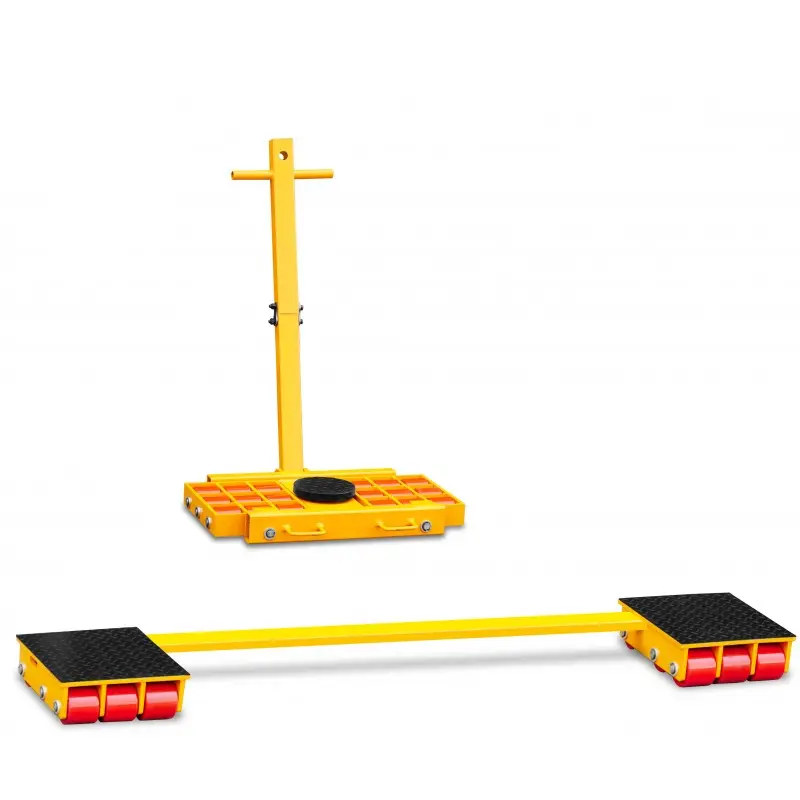
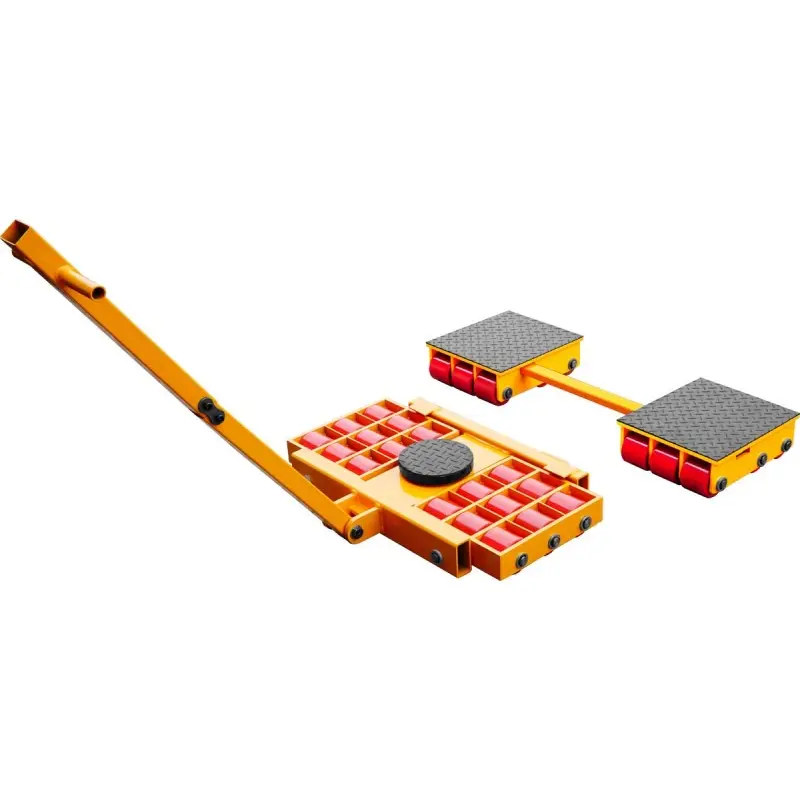
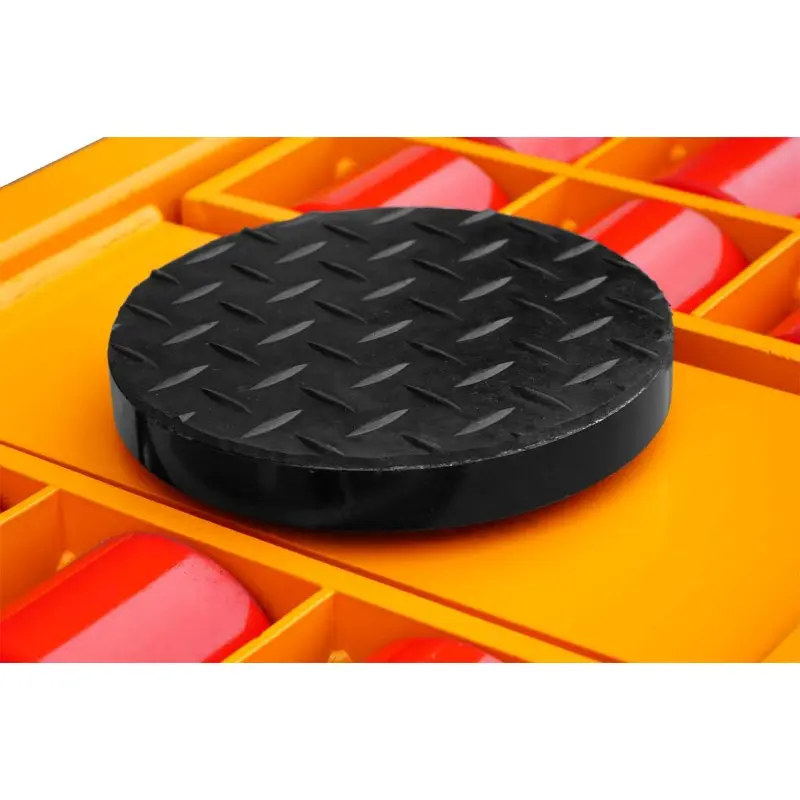
Transport Roller Set 21.6T (WL18 + WF18)
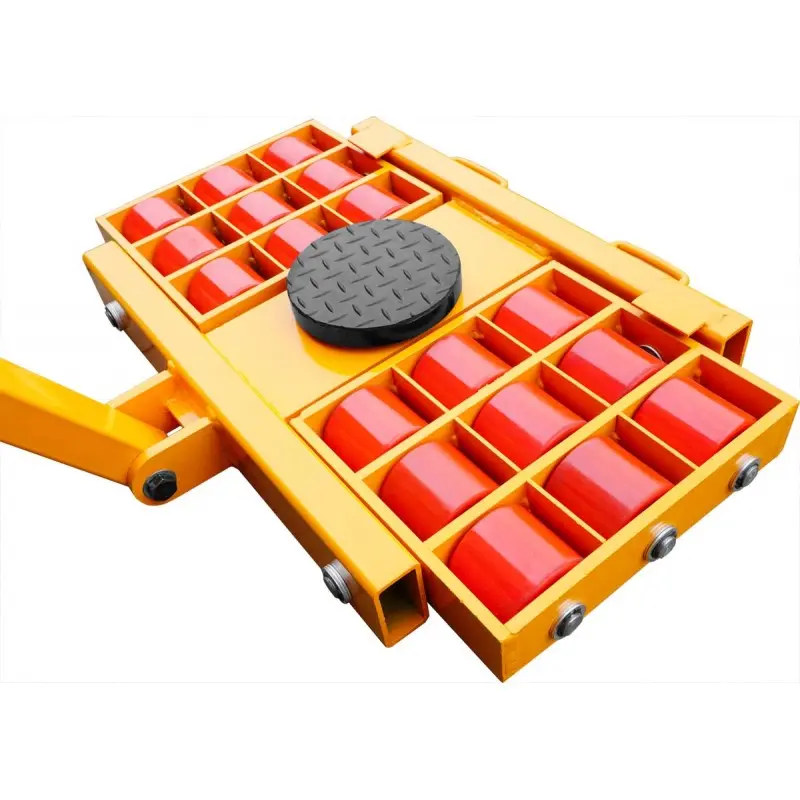
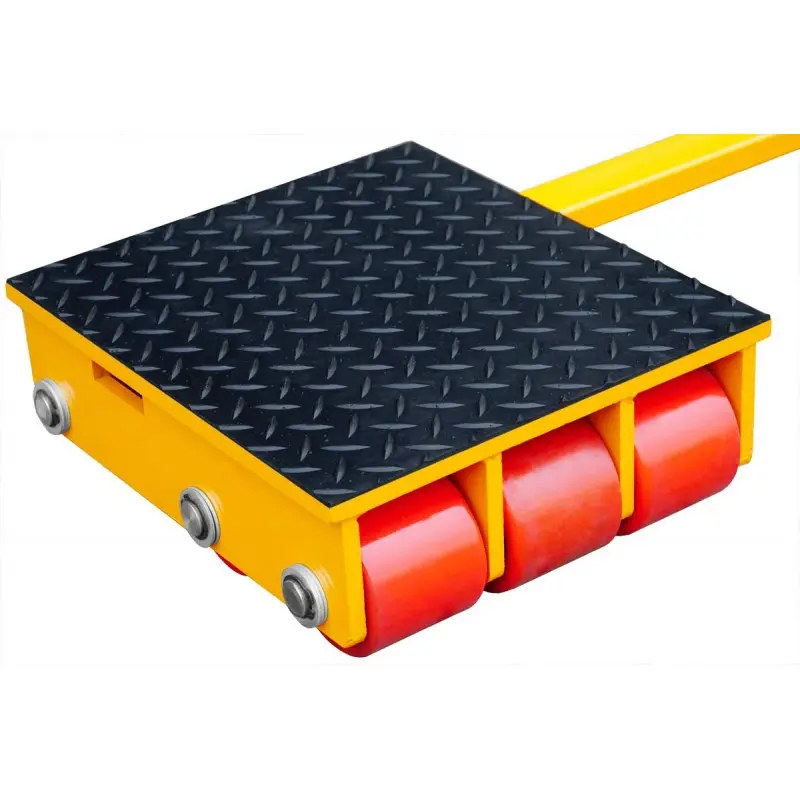
The WL18 + WF18 transport set has a working capacity of 21,600 kg — the load it will actually carry while moving. Data sheets list this set as "36 tonnes", but 36,000 kg is the static capacity: the load at standstill, evenly distributed, on a flat and hard floor. Moving a machine is governed by the dynamic capacity, which runs at about 60% of static — a ratio the manufacturer states outright for the sister WL12/WF12 series (7,200 of 12,000 kg). That gives 10,800 kg per unit and 21,600 kg for the set. Construction: each unit runs on 85×85 mm polyurethane-treaded rollers that protect the floor from marks and scratches, dampen vibration and noise, and keep traction on concrete, epoxy and industrial flooring. The 110 mm loading height lets you slide the set under a machine raised with a claw jack, without elaborate lifting. WL18 is a steering platform with a 1080 mm drawbar and ±90° steering range; WF18 is a two-point chassis with a connector adjustable from 1014 to 1430 mm to match the load width. Large bearing surfaces (Ø170 mm and 200×407 mm) distribute pressure evenly and reduce the risk of tipping. One important note on sizing: never pick capacity that only just covers the load. When starting, braking or crossing a threshold, expansion joint or uneven floor, the load momentarily shifts onto one side of the set and a single unit then carries far more than a simple division of machine weight by the number of support points suggests. Allow a 30–50% margin over the machine weight — the set works comfortably with machines up to roughly 14–16 tonnes. VAT invoices issued.
Technical data
| Set working capacity (while moving) | 21 600 kg (wyliczenie, 60% statycznego) |
| Set static capacity (stationary) | 36 000 kg |
| Roller tread | poliuretan |
| WL18 — static capacity | 18 000 kg |
| WL18 — working capacity | 10 800 kg (wyliczenie) |
| WL18 — roller size | 85×85 mm |
| WL18 — loading height | 110 mm |
| WL18 — bearing surface | Ø170 mm |
| WL18 — support points | 1 |
| WL18 — drawbar length | 1080 mm |
| WL18 — drawbar steering angle | ±90° |
| WL18 — dimensions (L × W) | 1030 × 620 mm |
| WL18 — weight | 137 kg |
| WF18 — static capacity | 18 000 kg |
| WF18 — working capacity | 10 800 kg (wyliczenie) |
| WF18 — roller size | 85×85 mm |
| WF18 — loading height | 110 mm |
| WF18 — bearing surface per unit | 200×407 mm |
| WF18 — support points | 2 |
| WF18 — connector length | 1430 mm |
| WF18 — cart spacing | 1014–1430 mm (regulowany) |
| WF18 — weight | ok. 50 kg |
| Standard equipment | 1× WL18, 1× WF18, dyszel 1080 mm, łącznik 1430 mm z regulacją |
What it is used for
- ▸Lathes, milling machines, presses, CNC machines and complete production lines
- ▸Transformers, generators and power equipment
- ▸Steel structures and industrial prefabricated elements
- ▸Construction and transport infrastructure components
- ▸Repositioning machines inside a hall — without a crane and without disassembly
- ▸Moving machines in and out where headroom is limited
FAQ
What is the difference between static and dynamic capacity?
Static capacity is the load the set will hold while standing still, evenly distributed, on a flat and hard floor. Dynamic capacity applies while moving and is lower for concrete reasons: under a rolling roller the polyurethane flexes and heats up continuously (material hysteresis limits the load × speed product), the bearings work in fatigue rather than pure compression, and every threshold, expansion joint or piece of swarf under a roller produces a momentary impact several times the static pressure. On top of that, starting and braking shift the mass onto one side of the set. That is why we lead with the dynamic figure — it is the number you actually size equipment by.
Where does 21.6 tonnes come from when the manufacturer says 36 tonnes?
36,000 kg is the static capacity — the load at standstill. The manufacturer does not publish a dynamic figure for WL18/WF18, but does publish one for the sister WL12/WF12 series: 7,200 kg against 12,000 kg static, exactly 60%. Applying the same ratio to 18,000 kg gives 10,800 kg per unit and 21,600 kg for the set. We say this openly: 21.6 t is our calculation from the manufacturer ratio, not a figure from their data sheet. If you are planning a move close to that limit, call us and we will work through it together.
How do I match this set to the machine weight?
Start from the working capacity — 21,600 kg, not the 36,000 kg headline. Then add load distribution: the centre of gravity is rarely exactly in the middle, and while starting, braking, turning or crossing uneven ground the load momentarily shifts onto one side of the set. A single unit then carries far more than dividing the weight by the number of support points suggests. That is why you never pick capacity that only just covers the load — allow a 30–50% margin. In practice this set works comfortably with machines up to roughly 14–16 tonnes. If the machine is tall, narrow or has a strongly offset centre of gravity (headstock, turret, counterweight on one side), increase the margin. Not sure of the exact weight? Call us — we will help estimate it and pick the right set.
How much does this set cost to rent?
400 PLN net per day (492 PLN gross at 23% VAT) plus a refundable 1000 PLN deposit. Longer rentals are cheaper: 4–7 days at 340 PLN net/day, 8 days and more at 290 PLN net/day. VAT invoices issued.
Will the rollers damage the floor?
The treads are polyurethane — they do not leave black marks like rubber and do not bite into the floor the way steel rollers do. The high roller count and wide bearing surfaces spread the pressure. Under full load, check the floor load rating and clear the route — most damage comes from gravel, swarf and screws pressed under a roller, not from the roller itself.
How do I get the set under the machine?
The loading height is 110 mm, so the machine only needs to be raised about 12–13 cm. A hydraulic claw jack is the easiest way (we rent 10 T and 20 T), or a lifting bar for lighter items. No forklift or crane needed — you can rent the whole kit from us as one package.
Can one person operate the set?
For steering the set with the drawbar — yes, once hitched one person is enough. For safely lifting the machine, positioning the units and watching the route we recommend at least two people. The units themselves weigh 137 kg (WL18) and about 50 kg (WF18), so positioning them alone can be awkward.
Do you rent to companies based outside Poland?
Yes. Most often we work with international manufacturers and integrators running an installation or relocation at a plant in Poland — in that case we deliver the equipment straight to the site and collect it once the work is done. Renting with delivery across the border is possible too, but it is quoted case by case, so tell us the location and the dates upfront. We invoice B2B and hold an EU VAT ID (PL6342227922). Write to us in English.
Do you deliver this equipment on site?
Yes. The WL18 + WF18 transport roller set for machine relocation — we deliver it across the Silesian agglomeration: Katowice, Gliwice, Zabrze, Bytom, Ruda Śląska, Chorzów, Sosnowiec, Dąbrowa Górnicza, Tychy, Mysłowice, Siemianowice Śląskie, Świętochłowice, Piekary Śląskie, Czeladź, Będzin, Mikołów, Knurów, Jaworzno, Tarnowskie Góry, Łaziska Górne, Bieruń and Lędziny. We bring the equipment to your address and collect it after the rental — a flat 300 PLN net round trip (delivery + pickup). Outside the agglomeration we quote transport individually — just give us a call.