- Machines 15–30 t need passive heavy-duty roller sets (21.6 t working capacity) and 20 t toe jacks; remote-controlled RC skates cover machines up to 15 t.
- Staged lifting with timber cribbing is standard — you don't go from floor to skates in one lift.
- Center of gravity and floor bearing capacity are critical — check both before starting.
- Skates handle in-hall movement; crane/HDS is usually only needed for loading onto a truck.
Relocating machines in the 15–30 ton range requires properly matched equipment, a prepared route, and careful work organization. This is a different league than moving a 3-ton CNC mill — the forces involved are massive, the margins for error are slim, and the consequences of a mistake are severe.
What machines weigh 15–30 tons?
- Large injection molding machines
- Press brakes
- Heavy CNC machining centers
- Large die-cutting machines (platen presses)
- Hydraulic presses
- Selected transformers and process equipment
Each of these requires individual assessment of: total weight, center of gravity, lifting points, floor bearing capacity, and route width and condition.
What equipment for 15–30 ton relocation?
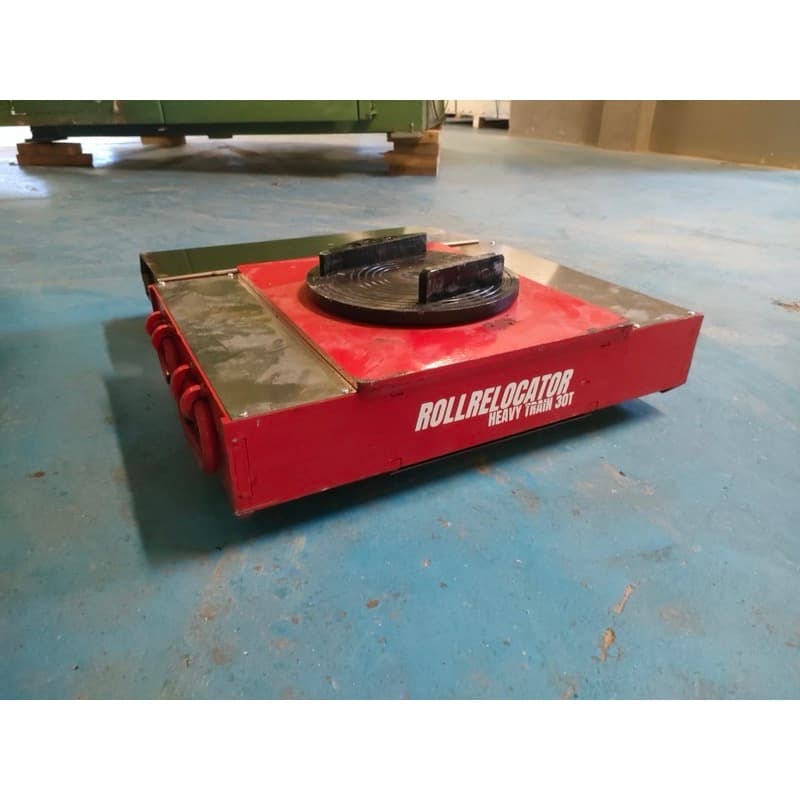
Up to 15 t — RC skates. Above that — passive roller sets
With heavy machine relocation, matching the transport set to the weight and load distribution is critical.
We rent remote-controlled RC skates for machines up to 15 tonnes. That is the ceiling for a reason: the maximum vertical load on the powered trolley is 15,000 kg, and a 15-tonne machine cannot exceed it no matter where its centre of gravity sits. Above that mass you would have to know the real load on each support point — and almost nobody measures that before a move.
Above 15 tonnes the work is done with passive roller sets — WL18 + WF18 with a 21.6 t working capacity — pulled by a winch or a forklift, together with 20 t toe jacks for the lifting. You give up remote steering, but at these masses what decides the outcome is load distribution across the support points and the condition of the route, not whether the set drives itself.
- Up to 15 t — RC skates, remote-controlled direction changes, no hands on the load
- 15–21.6 t — passive WL18 + WF18 set, external traction, steered with the drawbar
- Above 21.6 t — an individual assessment; this is no longer a self-service rental job
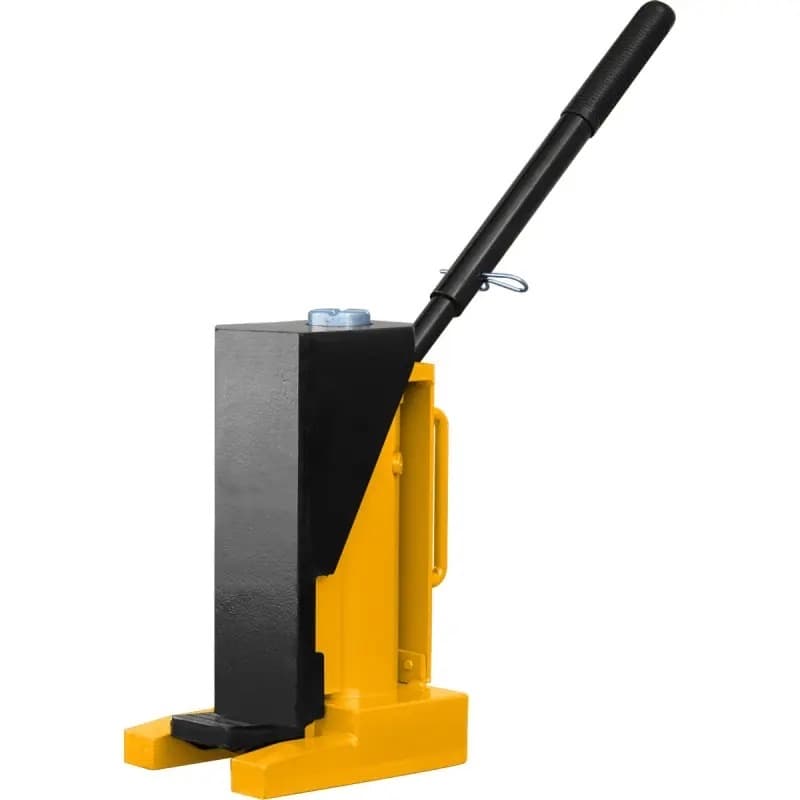
20-ton toe jacks
For machines 15–30 t, toe jacks are the essential tool to start the entire operation. They're used for:
- Lifting the machine off the floor
- Placing timber cribbing or other supports
- Creating clearance for transport skates
- Lowering the machine onto feet or foundation at the destination
In this weight class, lifting is always staged. It's not just about lifting capacity — it's about stability of the entire operation.
Timber cribbing and supports
With heavy machines, staged lifting using timber cribbing, support blocks, and (when necessary) steel plates is standard. This allows you to safely increase lifting height incrementally and create the clearance needed for transport skates. You don't go from floor level to skate height in one jack stroke — you build up in stages, securing each level before going higher.
Why center of gravity matters at 15–30 tons
At this weight class, knowing total mass alone is not enough. You also need to account for:
- Where the center of gravity is located
- Which part of the machine carries more weight
- How to distribute load across skates and lifting points
This matters when:
- Selecting equipment — the heavier side needs more capacity
- Positioning skates — offset center of gravity means offset skate placement
- Planning direction of travel — the machine will want to veer toward its heavy side
- Turning and maneuvering — 20 tons pulling sideways during a turn is a serious force
If the machine has uneven weight distribution, the transport setup must account for this from the planning stage.
Floor bearing capacity
With machines 15–30 t, you need to assess not just the machine but the entire route.
Before starting, evaluate:
- Floor bearing capacity (concrete thickness and quality)
- Expansion joints — skates can catch or drop into them
- Utility channels in the floor
- Steps and thresholds
- Sections with deteriorated concrete
For heavy point loads, it's common to use:
- Steel plates to spread the load
- Load-distribution boards
- Bridging over cracks or weakened floor sections
How does a 15–30 ton relocation work?
- Verify weight, lifting points, and center of gravity
- Assess floor condition and prepare the route (steel plates, bridging)
- Unbolt the machine from its foundation, if anchored
- Lift with 20 t toe jacks — first stage
- Place timber cribbing under the machine
- Stage-lift to the height needed for skates
- Position the roller set sized to the machine mass
- Move the machine to the destination — controlled, slow, with spotters
- Remove from skates, lower onto feet or foundation
Depending on the machine size, route length, and hall conditions, this operation takes from a few hours to a full working day.
When skates, when crane?
Transport skates are the right choice when:
- The machine needs to be moved inside the hall
- You need precise positioning
- The route is prepared and the floor can handle the load
- The machine can be safely lifted with jacks
In practice, the most common setup looks like this:
- Skates handle all in-hall movement
- Crane or HDS is only needed for loading onto / unloading from a truck
This means you rent skates for the whole operation and only pay for a crane for the loading/unloading moment — not for the entire relocation.
- 2× RC skates 15 t — remote-controlled, for machines up to 15 tonnes
- WL18 + WF18 roller set (21.6 t working) — for machines above 15 tonnes, external traction
- 20-ton toe jacks — staged lifting from 35 mm clearance
Summary
Relocating machines 15–30 tons requires:
- Equipment matched to the mass (RC skates up to 15 t, passive sets above, heavy jacks)
- Center of gravity assessment
- Floor bearing capacity check along the entire route
- Staged lifting with proper supports
- Controlled, slow movement with dedicated spotters
Skates and jacks handle the in-hall part of most heavy relocations — from the first lift to the final position — provided the set is honestly matched to the mass and to the load on each support point. Not every 15–30 t machine is a self-service job: the heavier it is and the further its centre of gravity sits from the middle, the more the outcome depends on assessment done before anything moves. The crane only comes in for the truck loading step.
* All timelines and recommendations in this article are based on experience from the Silesia region (southern Poland) as of early 2026. Actual requirements may vary depending on machine type, floor condition, and site specifics.
Relocating a machine 15–30 tons?
RC skates rated for 30 tons, 24-ton rear skates, 20-ton toe jacks — the full heavy relocation set, delivered to your site.
Get a quote →We're based in Silesia (southern Poland) and help with industrial machine moves across the region. Tell us what you need — machine type, weight, timeline — and we'll get back to you with options.
kontakt [at] r5rent.pl (click to reveal)